Cloud Communications as the Modern Communications Hub
For years, business communications were fragmented. The name “unified communications” was used, but it was more of an aspiration than a reality. Email lived in one place, phone systems in another, chat in a third, and meetings somewhere else entirely. Teams spent more time switching between tools than actually collaborating.
Today, cloud communications has evolved into something much more powerful: a central communications hub that brings people, conversations, files, and systems together in one cohesive platform.
Rather than thinking about voice, video, and messaging as separate tools, organizations are now leveraging cloud communications as the backbone of how work actually gets done.
One Platform for True Team Collaboration
At its core, a modern cloud communications platform enables teams to share information, collaborate on documents, and store critical content in a secure, centralized repository. Instead of information being scattered across inboxes, desktops, and personal devices, everything lives in a shared workspace that’s accessible and searchable.
This creates a single source of truth for conversations, files, and decisions—making it easier for employees to stay aligned and productive, especially in hybrid and remote environments.
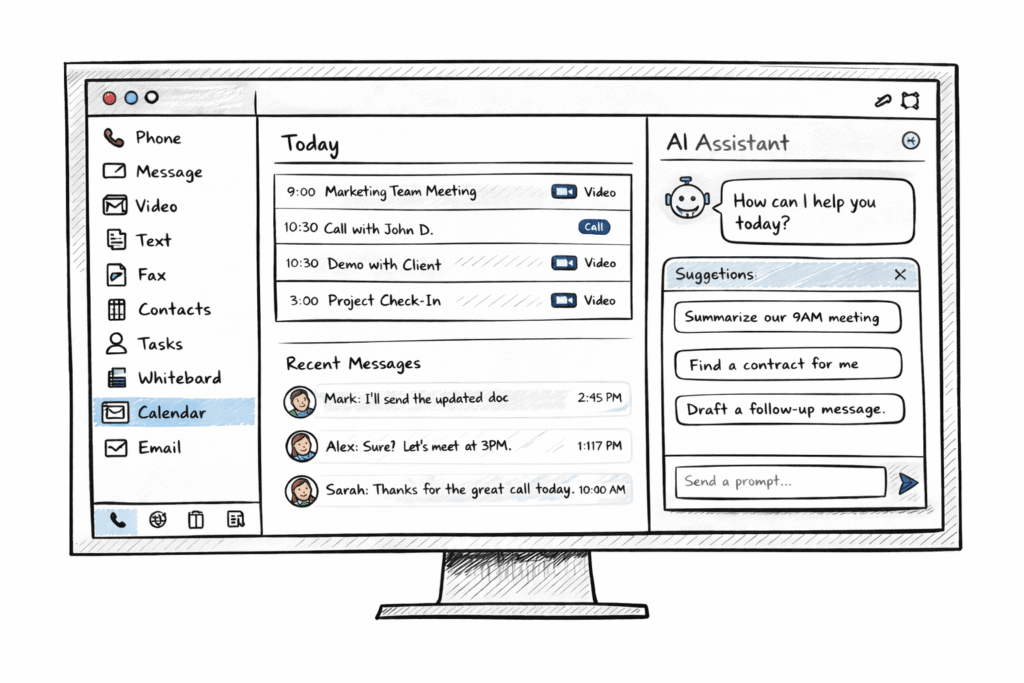
Communications Hubs provide access to all core functions in a single view
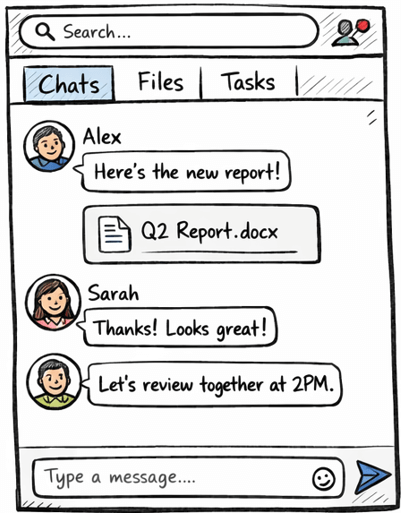
Messaging allows for immediate access and better collaboration.
Instant and Persistent Messaging
Cloud communications also introduces instant and persistent messaging, allowing employees to communicate in real time with colleagues or even external clients. Unlike traditional SMS or email, these conversations don’t disappear. They remain available for reference, searches, compliance, and knowledge sharing.
This persistent communication model dramatically reduces internal friction. Questions get answered faster, decisions are documented naturally, and teams avoid the endless back-and-forth that slows down workflows.
Seamless Integration with Business Tools
One of the biggest advantages of using cloud communications as a hub is its ability to integrate with the tools your teams already rely on.
Platforms like RingCentral, Zoom, or Microsoft Teams connect directly with Google Workspace and Microsoft 365, enabling users to schedule meetings from their calendars, collaborate on shared documents, and surface communications directly inside the applications they use every day. Several even let you connect directly to your email, allowing a single space where you can check all messages.
This tight integration eliminates silos and turns communications into a natural extension of the business process.
Escalate Conversations Instantly
Not every conversation needs to be a meeting—but when it does, cloud communications makes escalation effortless.
With a single click, users can move from a chat to a voice call or video meeting without switching platforms or losing context. The conversation, participants, and shared content all carry over seamlessly. Other people can be dynamically added as needed.
This dynamic escalation supports how people actually work: start informally, then bring in richer communication only when needed.
Calling and video are available with a single button.
Smarter Meetings with Shared Workspaces
Modern cloud platforms also offer virtual meeting rooms with shared whiteboards, collaborative notes, and real-time screen sharing.
Instead of meetings being isolated events, they become working sessions where ideas are captured, documented, and saved for future reference. This improves accountability, knowledge retention, and follow-through across teams.
Record, Transcribe, and Retain Knowledge
Another powerful feature of cloud communications is the ability to record and transcribe calls and meetings automatically.
This creates a living knowledge base of conversations—perfect for training, compliance, onboarding, or simply making sure important information isn’t lost. Teams can revisit discussions, search transcripts, and share key insights with stakeholders who couldn’t attend.
In many organizations, this alone delivers enormous long-term value.
Work From Anywhere, Without Limitations
Perhaps the most transformative benefit of all is location independence.
Cloud communications can be accessed from a desktop, desk phone, tablet, or mobile app—without any dependency on physical location or office infrastructure. Employees can stay connected whether they’re in the office, at home, traveling, or working in the field.
For distributed teams, this isn’t just convenient—it’s essential.
Cloud communications allows for connecting anytime, anywhere.
More Than Communication: A Strategic Business Hub
When implemented correctly, cloud communications becomes more than just a phone system. It becomes the digital hub of the organization:
A place where conversations happen
A system where knowledge is stored
A platform that connects people, tools, and workflows
A foundation for better customer and employee experiences
At Cloud Design Solutions, we see organizations achieve the most value when they stop viewing cloud communications as a replacement for legacy phones—and start treating it as a strategic collaboration platform that powers how work gets done.
In today’s business environment, the companies that win aren’t just the ones that communicate. They’re the ones that communicate intelligently, cohesively, and without friction.